
For a while, I have wondered how investments in the climate tech industry are made. As someone with a pure STEM background (physics and atmospheric science), I never had a chance to really think about this. I was a researcher… I am a researcher, I think, but now with a spin of business development? It wasn’t until I finished my master’s and started working for businesses in the climate tech industry that I really pondered this question.
You don’t need a tech or business background to follow along, and I’ll try to keep the buzzwords to a minimum. In my opinion, the best way to do this is to jump right into the mathematics of it. For this, I’ll do a deep dive into Hardwiring Sustainability into Financial Mathematics: Implications for Money Mechanics by Armen V. Papazian, an elegant book that takes us on a journey of sustainability mathematics, with an added twist of my own comments.
Did you know climate tech investment has grown to around $1–2 trillion annually, but most scenarios say it must reach $3–5+ trillion per year by 2030–2050 to stay on the 2°C pathway? That’s a massive number, and it brings me to the question: how do you even put a price on climate investment?
Imagine a person with the power to write all the financial rules. They want to take the fewest chances and make as much money as possible within their lifetime. They don’t care about the future. From a financial standpoint, this stakeholder is called a mortal, risk-averse, return-maximising investor. To serve this investor’s needs, finance depends on two fundamental rules. First, there’s the idea that the value of a dollar in your pocket right now is more than its value in the future, simply because if you invest that dollar, you will earn interest on it later. This principle is called the Time Value of Money.
Second, this investor hates losing, so if there’s more risk in an investment, they demand a premium to take that gamble. From their perspective, high risk demands high reward. This is the principle of risk and return.
These fundamental principles create holes when the perspective shifts towards long-term investments, also known as evolutionary investments. Think about massive global challenges like achieving a net-zero economy. Because this requires a massive flow of upfront capital while involving a high degree of uncertainty about the likely distant future returns, traditional finance penalises these climate investments.
Now the question is: what’s missing? The financial models are focused on risk and time; however, they don’t include responsibility for how these investments impact the planet. This impact on the physical world is referred to as space. Adding space to the equation changes the model’s perspective from 2D to 3D.
Now think of a scenario where you are the “mortal risk-averse investor” and you have been given a bunch of cash to choose which project is worth funding. They all promise you future payouts, but you have to figure out how much that uncertain future cash is worth today. The shrinking value of that money is calculated using the process of discounting.
The combination of what you spend today and the shrunken value of future payments gives a final score called Net Present Value (NPV).
NPV = −II + Σ CFₜ / (1 + r)ᵗ, summed from t = 1 to n
The first part is the initial investment (−II) spent on the project; the negative sign just means cash outflow. CFₜ represents the expected future payment that you will get from the investment, whereas the discount rate r is the penalty applied to future payments for delay time t and risk. Since the project will run for a certain period, that number is given by n, in years.
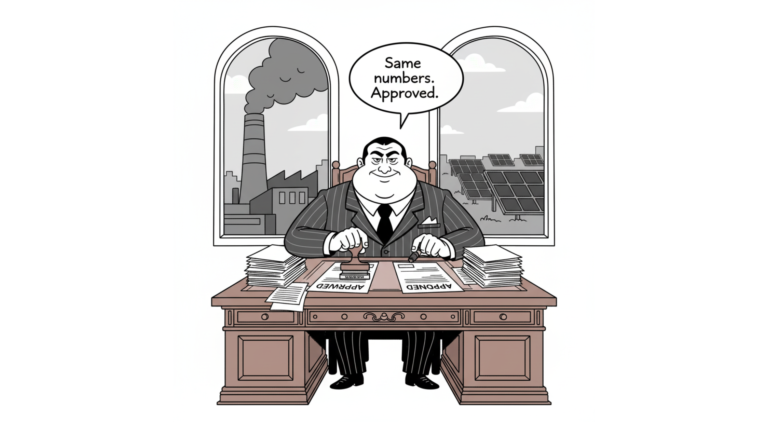
The problem with this NPV equation is that it completely ignores the impact of space. For example, you decide to invest $1,000,000 each in a coal plant project and a solar farm project. Both are expected to generate $300,000 a year for 5 years. The only issue is that the coal plant will emit massive amounts of CO₂ while the solar farm emits none. However, since CFₜ and the discount rate r are identical for both, both projects will show the same NPV. The equation, entirely ignoring the environmental impact, will suggest that both ventures are profitable.
Let’s look at one more model that suffers from a similar lack of space. Taking the same example above, let’s say you need to determine how much of a bonus return you should demand to justify investing in either of these projects, because ultimately you are taking a risk in this investment instead of just putting the money into a safe government bond. The Capital Asset Pricing Model (CAPM) gives you a number for that demand by measuring their risk (a metric known as Beta). Simply put, Beta is a measure of how much a company’s stock price goes up and down compared to the rest of the market. If this pattern is similar for both companies, then they are both assigned the same risk score. This means that CAPM demands the same bonus return from both companies. The model relies on past price charts and has no clue what companies actually do in the real world or what impact they have on the planet.
Looking at just these two fundamental equations governing millions of capital investments, are you really surprised by the current state of the world? I think it’s a good time to remind ourselves that taking responsibility for the environmental impact of our investments is not optional; it is the dimension we have been missing all along.