
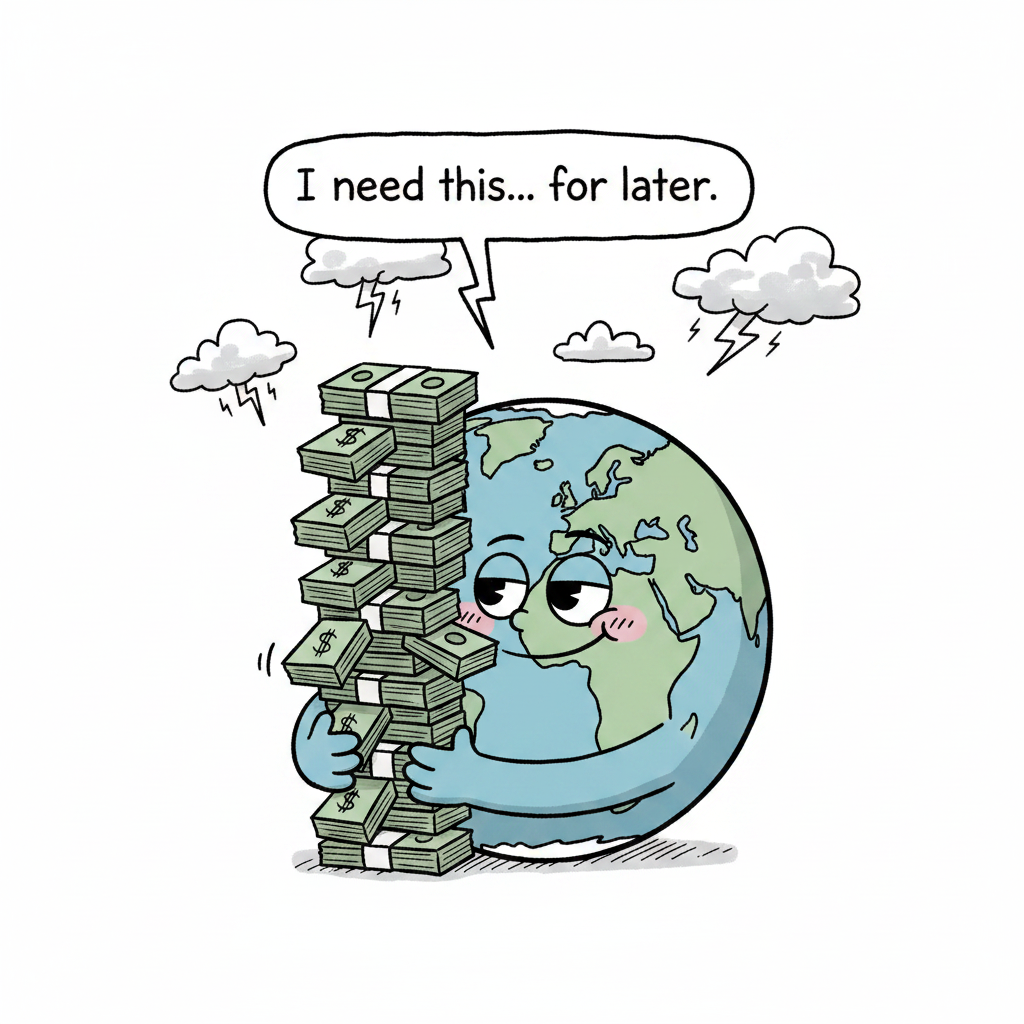
While driving you come across a warning light on your dashboard. It’ll cost 100 bucks to fix it right now. You think, I’ll just do it later, six months later your car breaks down in the middle of a ride. Now you’re paying thousands to replace the entire engine.
Congratulations, you just learned how decarbonization investment works.
How we handle this investment mostly comes down to perception. Do we treat it like a gamble, or like insurance?
For decades, climate policy has been treated like a gamble. Several critics argue we should wait for better technology and cheaper options, before committing trillions in capital. It’s the same logic as putting off the car repair and we all know how that ends. It blows up in our faces.
In the present, global investment in sustainable finance is around 1.3 trillion dollars a year, which sounds massive until you realize that only accounts for 1 percent of global GDP. To actually hit the Paris Agreement targets, the number needs to grow by at least five times. So the debate over timing isn’t some abstract academic argument. It’s the difference between closing that gap now or watching it get five times harder to close later.
Here’s the thing though, you can’t just snap your fingers and switch the entire global economy to clean energy overnight. It doesn’t work like that. Every real transition comes with what economists call adjustment costs.
Imagine a government wants to switch an entire city to solar power. If they take ten years to do it, they can scale up slowly. Train electricians, build supply chains, grow the workforce gradually. In the second scenario, they try to do the exact same thing in 1 year instead. Now there’s a skilled labor shortage. They have to import workers from other countries just to keep up. Prices spike because everyone is competing for the same limited pool of solar technicians. That shortage, that price spike, is the adjustment cost.
And this isn’t just a hunch. Researchers modeling this found that once you factor in these real world adjustment costs, the total cost of climate policy comes out about 7 percent higher than a simplified model that pretends the economy can shift instantly. Seven percent might not sound dramatic, until you remember we’re talking about trillions of dollars.
Why We’re Attacking This Backwards
Should we go for the sectors that are easy to decarbonize first, or the ones that are hardest? This research found the opposite of common sense makes more sense here. For sectors like agriculture and transportation, sometimes called “hard to abate” sectors, these are the hardest to decarbonize and also the sectors that keep emitting the most every single year we delay. The longer we wait to invest in them, the more emissions pile up that we’ll eventually have to undo. So counterintuitively, we should be investing in the hardest, most stubborn sectors first, not last. And when bad news does hit, when it turns out we have less room to work with than we thought, it’s these exact sectors that see the sharpest emergency spike in investment. Easier sectors like energy barely need to budge.
The Number Nobody Knows
This is where the idea of a carbon budget comes in. It’s the total amount of greenhouse gas we can still emit before we blow past the 1.5 degree Celsius target. And here’s the catch. Nobody knows how big that budget really is. For a 1.7 degree target, scientists estimate it’s somewhere around 770 billion tons of CO2, but that number could easily swing plus or minus 220 billion tons in either direction. This is a massive uncertainty sitting underneath one of the most important numbers in the world.
Think of it as a faucet running full blast in a bathtub which has a limited capacity. That water is our emissions. We can only control the faucet handle, turn it down gradually, starting now, or leave it running like normal and then slam it shut at the very last possible second. Right now the world is emitting close to 40 billion tons of CO2 a year. In a true worst case scenario, that alone could burn through the entire remaining budget in as little as 7 to 13 years.
The Insurance Premium We Can’t Avoid
We tend to think of sustainability as some abstract, feel good, academic idea. But the research shows it’s actually a financial strategy. The paper found that learning the truth about our carbon budget just one year sooner could be worth up to a trillion dollars in savings. Because the alternative, waiting and finding out late, means an emergency shutoff at the last second that costs far more than gradually turning down the handle now.
Early knowledge and early spending is the whole game here. But the cost of waiting doesn’t grow steadily. It grows exponentially. The longer we wait, the worse the bill gets.
It really comes down to this. Either we pay a smaller insurance premium today, or we end up paying a massive one tomorrow, when it’s no longer optional.
That’s why I say the most expensive climate policy is always the one we wait to start tomorrow.
Next time someone says we should wait and see, ask them what they think a blown engine costs.
The specific economic framework that we talked about, builds a compelling argument however when we’re dealing with the messy, unpredictable reality of a changing climate, there’s almost never a single solution.
This breakdown is based on the paper published in Earth’s Future by Adam Michael Bauer, Florent McIsaac, and Stéphane Hallegatte, titled “Decarbonization Investment Strategies in an Uncertain Climate.”