
Just a century ago, long range weather forecasts carried the same accuracy as a flip of a coin. We have come a long way from that period, but predictions still remain difficult even with supercomputers, mainly due to the sheer complexity of Earth’s physics.
So where does that leave us in 2026? According to Dr. Claire Monteleoni, the sudden AI boom in the climate industry we’re seeing today is actually standing on the shoulders of a “quiet revolution” (Bauer et al., Nature 2015) which comes from decades of steady, unsung improvements in traditional forecasting.
The focus right now is clear: use AI to develop tools that can predict the climate crisis.
Since the history of weather forecasting, we have relied on physics models that run mathematical equations to work out how the atmosphere behaves. That method is called Numerical Weather Prediction, or NWP, and it’s the standard, non AI approach that supercomputers have used for decades. But scientists aren’t leaning on it alone anymore.
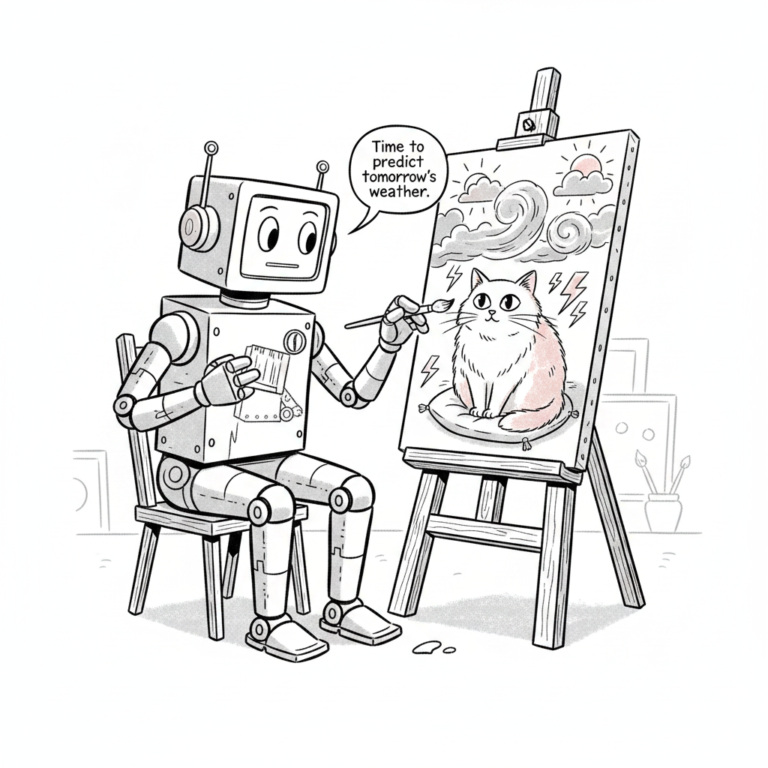
The Cat That Became a Weather Map
The first wave of AI weather models to challenge NWP, models like Pangu Weather(Bi et al., Nature 2023) and GraphCast (Lam et al., Google DeepMind), work through something called autoregression. The model predicts the next weather state using data from the current one, then feeds that prediction right back into itself to predict the next state, again and again.
One thing to note is that it isn’t picking up new patterns on the fly. It learned all its patterns during a massive, one time training phase on historical data. When it generates a forecast, it’s rapidly fast forwarding what it already knows.
To test just how deeply these physical patterns were ingrained, researchers tried a bizarre experiment on one of these models: instead of giving it starting weather data, they fed it a picture of a cat. Researchers let the loop run through 56 consecutive steps. With every single step, the model lost a little bit of its dependence on that initial starting image. By the 56th loop, the cat had been completely washed out, transformed by the model’s rigid mathematical rules into a realistic map of global weather. This shows us that the AI is so heavily anchored to the physical laws it learned during training that , even if you feed it total nonsense, its internal mechanics will eventually force that nonsense back into a physically plausible reality(Leman et al., arXiv).
(Note: You can find the specific cat experiment in Appendix 9 of the paper “Can AI weather models predict beyond two weeks.”)
Speed of New AI Models
Now, I should point out that training these AI models is resource heavy and expensive. But unlike commercial models such as ChatGPT or Claude, used to generate images and chat about virtually anything, AI weather models don’t need to function that way, because they are “right sized” and focused strictly on the variables of climate data. Once trained, they run remarkably fast.
Here’s a number that puts it in perspective. A traditional NWP requires 11,664 CPU cores and 6 hours to run a 10 day forecast. Compare that to Pangu Weather(Bi et al., Nature 2023) and GraphCast (Lam et al., Google DeepMind), which can run the same task on a single GPU or Cloud TPU v4 in under 2 minutes.
How AI Still Learns the Physics
But this raises another question: if these models work with the patterns rather than the physics directly, how do they still understand the laws of atmospheric physics? This is where the ERA5 dataset comes in, essentially a re-analysis of Earth’s history, and the concept of data assimilation. It’s not that NWP models aren’t working anymore. Scientists take messy real world observations from different sources (weather balloons, satellites, all sorts of data) and feed them into a physical model, making sure the observations match the working physics laws. This creates a gridded history of the globe. The AI then learns these patterns ingrained with the trained physics laws. This is why these newer models rely so heavily on ERA5 reanalysis data.
Why “Average” Forecasts Fail
Here’s the catch with Pangu Weather, GraphCast, and models like them: they’re deterministic. They’re trained to output a single forecast by optimizing for the lowest average error, a metric called Root Mean Square Error, or RMSE. This error pushes the model toward an average outcome, to minimize itself. What this means, for example, is that if a cyclone is heading toward a landmass, the model might see multiple possible paths. Say the cyclone could hit New York, hit Boston, or just pass through without making landfall. What a deterministic model does is come up with a mathematical average that places the storm right in the middle of all three outcomes, and that produces “blurry” predictions that fail to map out any real path, let alone capture extreme events like the cyclone itself.
So how do you fix that? With generative AI weather models like GenCast and ArchesWeatherGen(Couairon et al., Science Advances 2026). Using generative techniques like diffusion or flow matching, they focus on creating probability classes, or “what if” scenarios (what scientists call probabilistic ensembles).
Going back to the cyclone example before, a generative model predicts various outcomes with different probabilities, such as 60% chance the cyclone hits Boston, 30% it hits New York, and 20% it passes through without landing. Instead of one blurry average, you get one possibility for every outcome.
Learning Without Labels
Now we understand that these AI models, deterministic and generative alike, don’t need to calculate physics directly. They just need to understand the pattern. But the problem is, weather data isn’t labeled all the time. What “labeled” means is that, usually, when traditional supervised AI models are trained, you would make them recognize what a storm looks like, for example, telling the computer, “this is a hurricane.” But when you have a huge amount of data, say you are forecasting the future by training on the last 45 years of hourly data, you don’t have the time or the resources to make humans label every single data point. To overcome this problem, scientists use self supervised learning.
For example, whenever you are learning a new language in school, the teacher walks you through it step by step, teaching you to recognize and spell the letters until you get everything right. But in self supervised learning, a student is handed an entire book with certain paragraphs blacked out. The student then has to fill in the blanks by guessing. The same thing works with these models.
The model masks a portion of the satellite data, then tries to predict the pattern that’s been masked. Do that enough times and it learns spotting the underlying physical patterns completely on its own!
Democratizing the Forecast
So what does all this mean for energy use? The very first wave of deterministic AI weather models were incredibly energy intensive to build. Initially, only big tech companies like Google, Huawei, and NVIDIA had the resources to train them, because they required massive GPU clusters grinding for weeks over extremely high resolution data grids.
This is also where the concept of Frugal AI comes in. The goal isn’t just to make the daily forecast fast, but to shrink the massive carbon footprint of that upfront training phase itself. The arrival of frugal academic models like ArchesWeather (Couairon et al., ICML 2024 workshop) proved you can train an AI much more efficiently. The team behind it trained on a coarser data resolution and used a clever architectural trick, replacing massive 3D calculations with simpler 2D and 1D mathematical “attention” windows(Couairon et al., ICML 2024 workshop). Because the math and data were “right sized,” the model didn’t require an intense supercomputing budget, opening the door for academic labs and developing nations to build their own climate tools without big tech computers.
That same team later extended the approach to generative forecasting with ArchesWeatherGen (Couairon et al., Science Advances 2026), proving that even the sharper, ensemble based forecasts don’t have to stay locked behind big tech’s budgets.
Where This Leaves Us
It’s safe to say that we’re moving toward a future where forecasts come with honest odds attached, not one blurry guess. And this doesn’t just help scientists. It also lets stakeholders see their risk clearly, so decision makers know exactly where to put their resources.
As we look toward the future with the power to emulate decades of climate data in seconds. What we do with that head start is the only question left worth asking.
This breakdown was inspired by Climate Change AI’s 2026 talk, “AI for Climate Science.” If this got you curious, check out the full talk here: https://www.youtube.com/live/95UjWbkxUFo